
The tokenized asset market has more than doubled over the past year, reaching around $60 billion in 2026, up from roughly $24 billion in mid-2025. It now spans thousands of products, including Treasury funds, private credit, and tokenized equities, with major issuers including BlackRock, Franklin Templeton, WisdomTree, Apollo, and Ondo.
The operational promise
The appeal is operational as much as financial. Tokenizing a fund is supposed to make the work around it easier and cheaper. A shared ledger should mean fewer duplicated records, less daily reconciliation, and lower costs for the companies that keep the fund running.
That work is expensive. The shareholder register — the record of who owns the fund's shares — can be a meaningful cost center on its own. Transfer agents often charge roughly $10 to $12 per shareholder account per year to maintain and reconcile the register. For a fund with several hundred thousand accounts, that becomes millions of dollars annually.
The gap
But putting fund shares on-chain does not automatically put the fund's books on-chain.
A fund is not one database. It's a network of operating companies. The manager runs the strategy. The administrator keeps the official books and strikes the NAV — the per-share price investors see. The custodian holds assets. The transfer agent maintains the shareholder register. Each has its own systems, records, and responsibility to make sure the fund's numbers are right.
Tokenization improves one part of that picture. Ownership and transfers may be recorded on-chain, making them easier to see and the shareholder register easier to inspect. But the fund still runs on operational records: shareholder registers, balances, transfer histories, cutoffs, totals, and audit populations.
Those records are not raw blockchain data. They are produced by indexers that read and interpret the chain.
Indexing is essential. Without it, every administrator, transfer agent, auditor, wallet, dashboard, and application would have to reconstruct the chain's history from scratch.
It also makes indexing a new operating dependency.
If the indexing layer misses an event, handles a reorg incorrectly, follows the wrong contract logic, or applies the wrong transformation, the books can drift from the chain even when the chain itself is public.
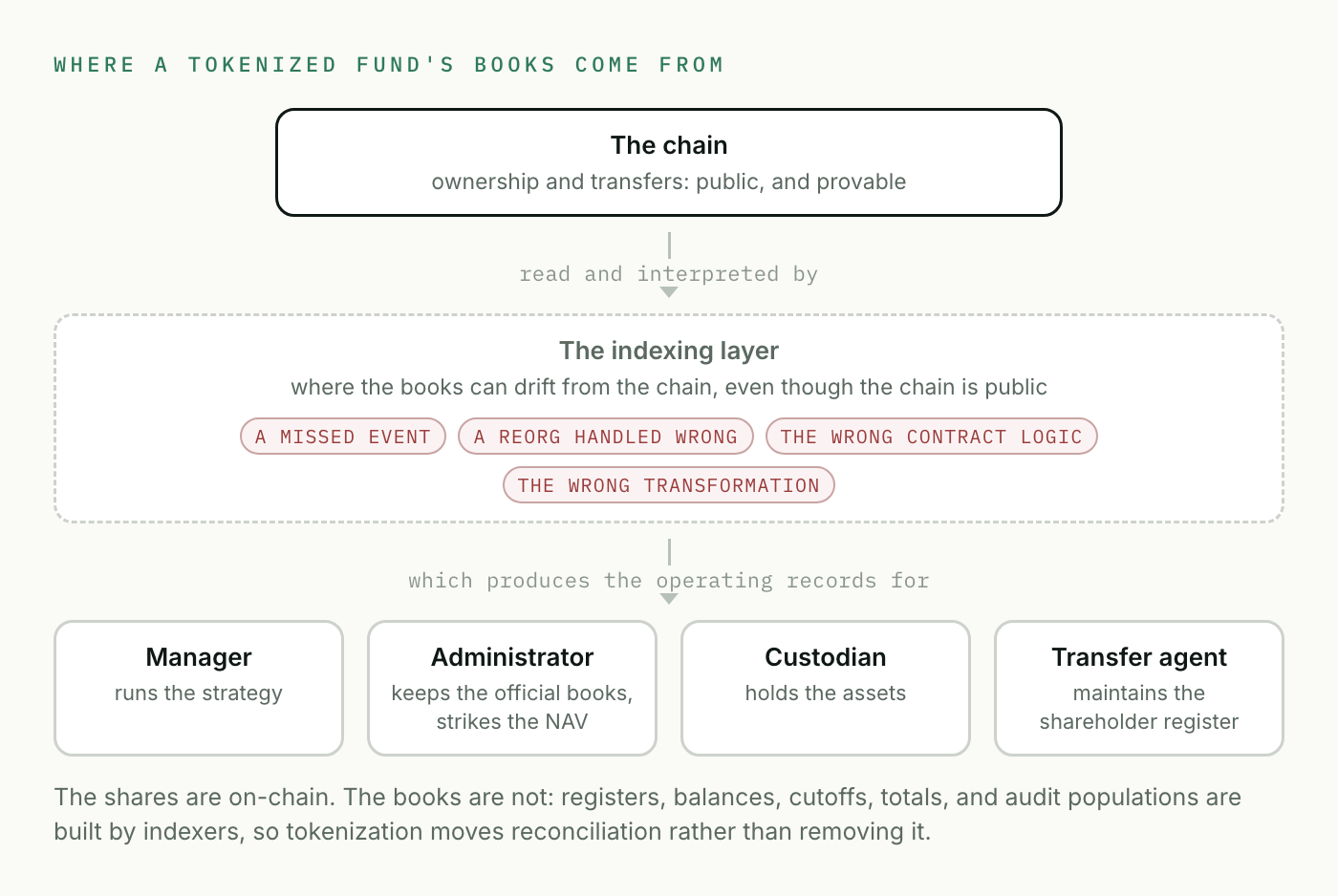
That means tokenization does not inherently remove reconciliation. It shifts the work to a new question:
Does the off-chain record actually match the chain?
Audit needs more than visibility
Auditors run into the same problem, just later in the cycle. Putting assets on-chain helps with visibility, but it does not answer the audit questions by itself.
A wallet balance proves that assets sit at an address. It does not prove the fund controls the keys. It does not prove the auditor has seen every relevant address. It does not prove every relevant transaction was captured. And it does not prove those transactions were correctly transformed into the fund's books.
The problem is not that the chain is hard to see. The problem is proving that the fund's systems read the chain completely and correctly.
Extending the chain's guarantee
There are a few ways to get confidence in indexed data.
One option is to run the indexing pipeline yourself, either inside the fund's own systems or separately at each party that needs to check the data. That gives each party more control, but it also means running infrastructure, handling reorgs, keeping up with contract changes, maintaining the logic, and duplicating the same work tokenization is supposed to reduce.
Another option is to use a service provider. That is simpler, but it turns the indexer into another source of trust. The administrator, auditor, transfer agent, and manager still need controls around that provider, and disagreements still have to be investigated.
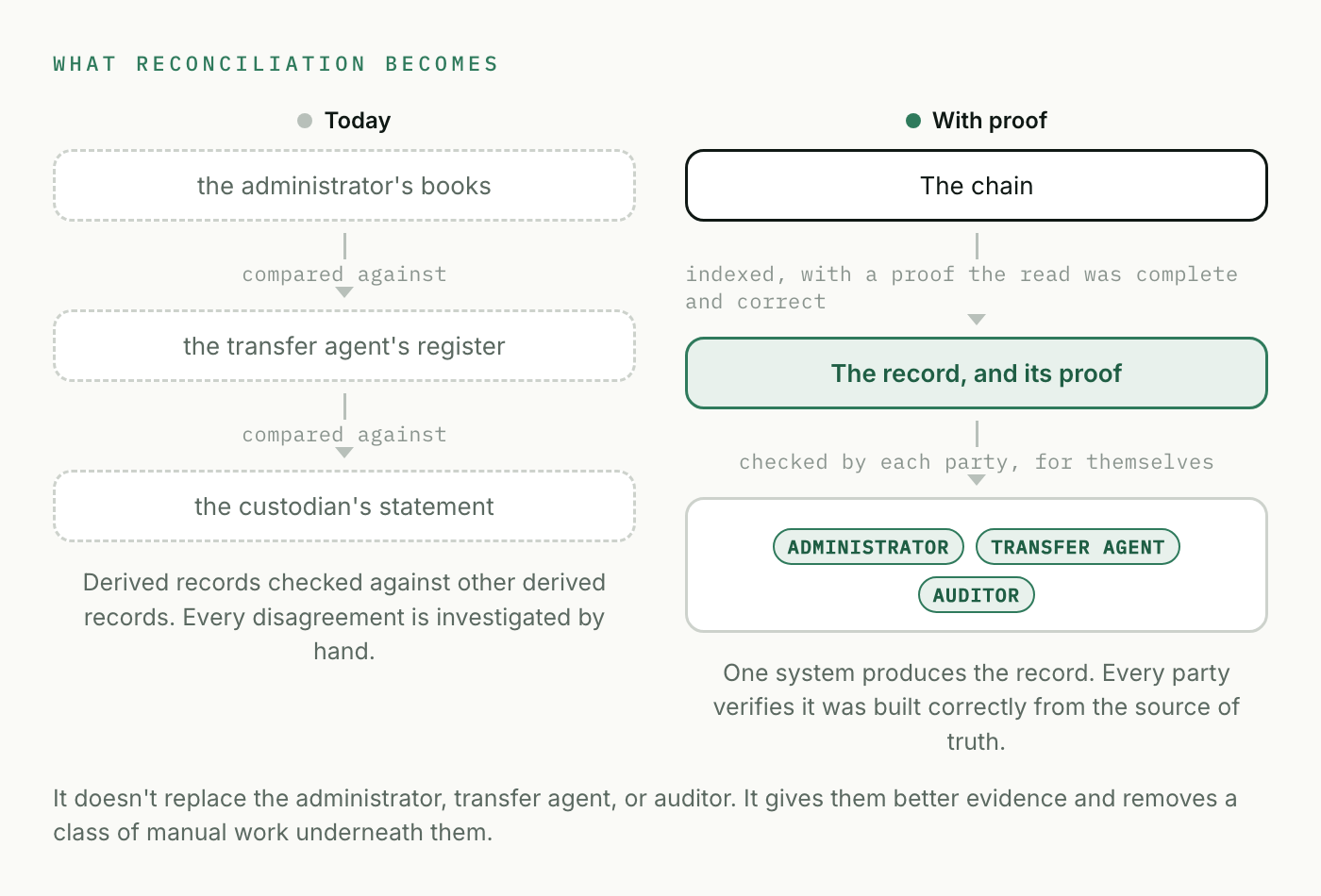
The ideal route would be to extend the chain's own verifiability to the indexing layer. On-chain data is already provable: you can fetch a piece of data and verify that it really came from the chain. But funds do not operate from isolated pieces of raw chain data. They operate from indexed records built from that data.
That is where cryptographic proof matters: a compact mathematical guarantee that someone can verify for themselves, without trusting the system that produced the data. One system can produce the records, but every party can check proof that the records came from the chain, that the relevant set was complete, and that the transformations were correct.
That changes reconciliation.
Instead of asking people to compare derived records against other derived records, the fund can verify that the record was correctly built from the source of truth. That does not replace the administrator, transfer agent, or auditor. It gives them better evidence and removes a class of manual work underneath them.
What Willow proves
That is the problem Willow is built to solve.
Willow is the first cryptographically verifiable indexer: it returns fund-ready records with cryptographic proof that they were built correctly from the chain. Instead of multiple parties re-executing the indexing pipeline — an extremely difficult and time-consuming task — they can verify the proof without trusting the indexer. The full proof pipeline runs on Ethereum today — where most tokenized-fund infrastructure already lives — with more chains to follow.
Willow proves three things:
- Inclusion — every record served really appears on the chain.
- Completeness — all relevant records are present, with none quietly omitted.
- Transformation — the calculations over those records are correct.
Completeness is the piece no-one else can prove.
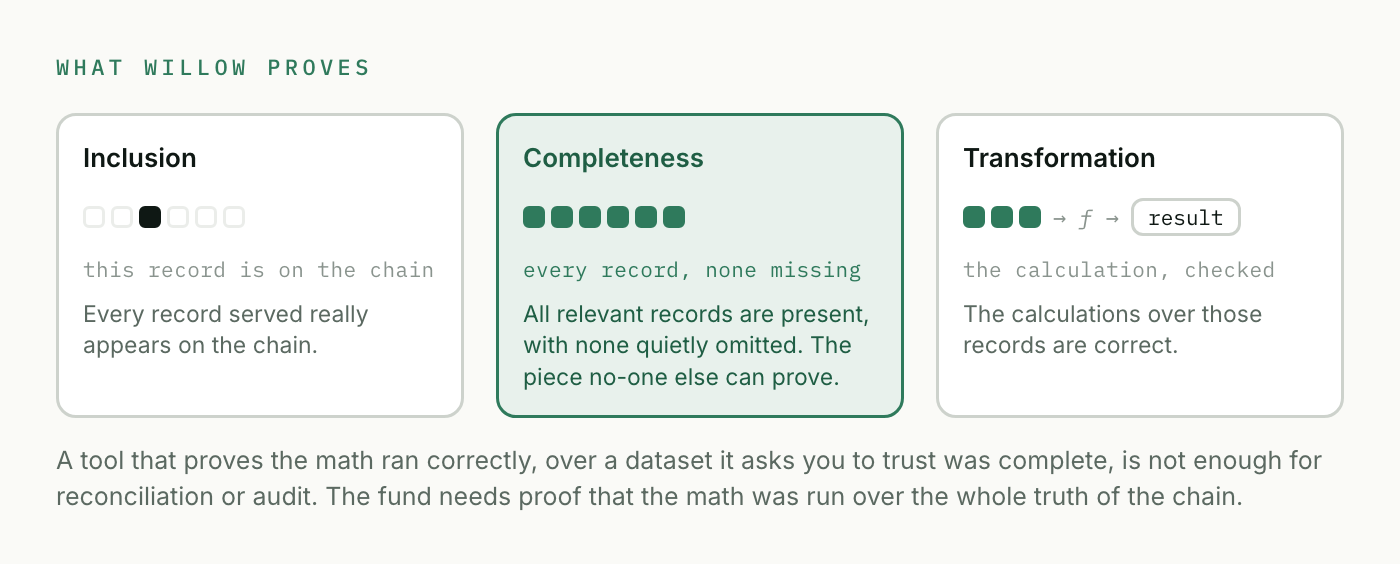
Existing "verifiable" tools can prove that a calculation ran correctly over a dataset while still asking the fund to trust that the dataset was complete. That is not enough for reconciliation, audit, or operating-cost reduction.
The fund does not just need proof that the math was right. It needs proof that the math was run over the whole truth of the chain.
Willow runs this on Ethereum mainnet today: inclusion, completeness, and transformation proofs that anyone can verify. It proves the data layer, not custody, and it covers the on-chain part of the books.
That is what tokenized funds need if they are going to deliver on the operational promise: books that do not merely claim to match the chain, but can prove it.